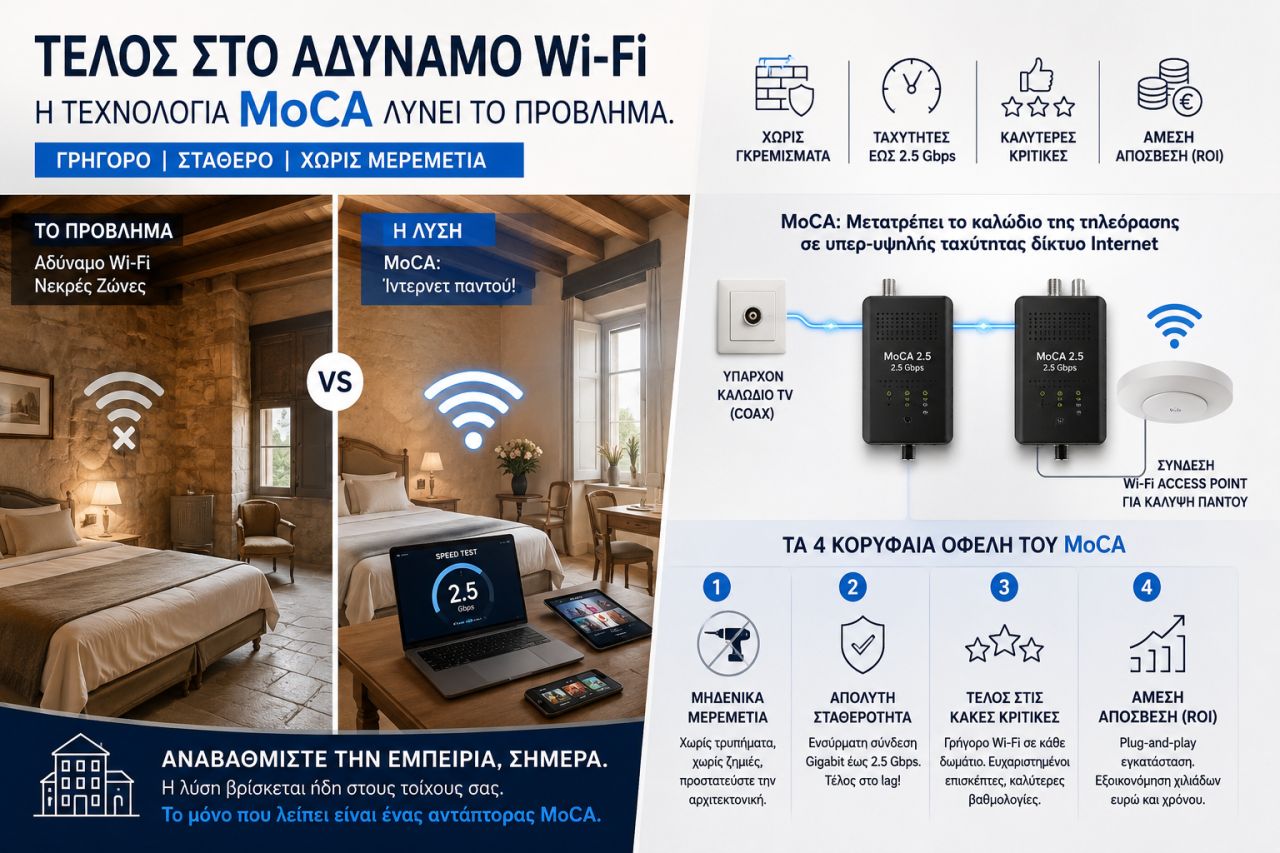
End Weak Wi-Fi: How MoCA Technology is Transforming Old Hotels and Grand Residences
An old hotel or large residence doesn't have to sacrifice its architecture to get modern, fast Internet. With MoCA technology, the existing coaxial network can be transformed into a high-speed infrastructure, without the need for new Ethernet cabling in every room.
A historic hotel can have a unique aesthetic, stone walls, and architecture that attracts visitors from all over the world.
A large residence may have spacious rooms, multiple floors, and dozens of locations where residents want reliable connectivity.
But there is a common problem:
Wi-Fi does not reach everywhere with the same quality.
Thick walls, long distances, different levels and construction materials can create dead zones and unstable connections.
For a hotel, this can lead to complaints and negative reviews.
For a home, it can mean buffering, slow speeds, and problems with streaming or video conferencing.
The obvious solution is to install new Ethernet throughout the building.
But in an old building, this can be expensive, time-consuming and destructive to the aesthetics of the space.
This is where MoCA technology comes in.
What is MoCA?;
MoCA (Multimedia over Coax Alliance) is a networking technology that allows high-speed data transfer over a building's existing coaxial cables.
Simply put:
The existing TV cable can be used to create a fast wired network connection.
This is particularly useful in hotels, villas, large residences and old buildings where there is already an installed coaxial cable network.
A MoCA adapter connects to the network and allows data transfer over existing coaxial cabling.
Then, at the point where a better connection is needed, you can connect a Wi-Fi Access Point or other network device.
So, instead of trying to make a single Wi-Fi Access Point cover the entire building, you can create more access points with a true wired backhaul connection.
Why is MoCA ideal for old hotels?;
Installing Wi-Fi in a modern building is relatively simple when Ethernet infrastructure is available.
In old hotels, however, the situation is different.
There may be:
thick stone or concrete walls many rooms many floors long distances between rooms old electrical installation restrictions due to historical character difficulty in installing new cables
Installing Ethernet throughout the premises may require work that affects the walls, rooms, and operation of the hotel.
MoCA offers a different approach:
Take advantage of the wiring that already exists.
4 important benefits of MoCA technology
- Fewer hassles and fewer interventions
Creating a new Ethernet network in an old building may require drilling, ducting, new cables, and work in rooms or common areas.
MoCA leverages the existing coaxial network.
This can significantly reduce the need for new wiring and limit interventions in the building.
For a historic hotel or a luxury villa, this has special value.
The technology adapts to the building, rather than the building having to change for the technology.
- Stable high-speed connection
One of the biggest problems of large buildings is trying to cover long distances exclusively via Wi-Fi.
Wi-Fi can be affected by:
walls floors distance interference other wireless networks construction materials
MoCA creates a wired connection over coaxial, which can be used as a backhaul for Wi-Fi Access Points.
With MoCA 2.5 technologies, network speeds of up to 2.5 Gbps can be achieved, depending on the equipment and existing installation.
This creates a much stronger foundation for modern Internet services.
For example:
4K streaming video calls smart TVs cloud applications online gaming professional applications fast browsing
- Better Wi-Fi in every room
MoCA doesn't necessarily replace Wi-Fi.
It reinforces it.
The ideal architecture could be:
Internet → Router → MoCA → Coaxial Network → MoCA Adapter → Wi-Fi Access Point
This way, you can install more Access Points in different rooms or parts of the building.
Each Access Point can be located closer to the user, while MoCA provides the network connection through the existing coaxial.
This is especially useful in hotels with rooms separated by thick walls.
Instead of trying to "pass" Wi-Fi through multiple walls, you can bring the network closer to the guest.
- Better experience for guests
For a hotel guest, Wi-Fi is now an essential part of the stay experience.
The visitor may want to:
make video calls with his family work from his room watch Netflix or another streaming service upload photos to social media use navigation apps connect to corporate systems hold online meetings
When the connection is slow or interrupted, the problem is not simply considered technical.
It affects the image of the entire hotel.
A modern and reliable Wi-Fi network can contribute to a better guest experience and reduce complaints related to connectivity.
MoCA for Villas and Large Residences
MoCA technology isn't just about hotels.
It is also particularly interesting for:
large detached houses multi-storey houses luxury villas country houses listed buildings houses with existing coaxial cabling
In a large villa, for example, the router may be located in one area while the office, bedrooms, home cinema and outdoor areas are located in different locations.
Covering the entire home with just one or two Access Points may not be the best solution.
With MoCA you can leverage your existing coaxial network to create additional networking points.
MoCA or new Ethernet?;
This doesn't mean that MoCA should replace Ethernet in every installation.
Ethernet remains one of the best options when there is easy access for new cabling.
But MoCA becomes particularly interesting when:
Ethernet is difficult, expensive, or disruptive to the building.
In these cases, existing coaxial can be a valuable infrastructure that is already within the walls.
The right solution always depends on the existing cabling, the building topology, the speed requirements and the equipment to be used.
How does a MoCA Wi-Fi network work in a hotel?;
A simple example of architecture is:
- Internet Connection
The Internet connection reaches the hotel.
- Main Router
The router manages the connection and the local network.
- MoCA Adapter
The MoCA adapter connects Ethernet to the existing coaxial network.
- Existing Coaxial Cabling
The signal is transmitted through existing coaxial cables.
- MoCA Adapter at every point
A second MoCA adapter is installed at points where network access is needed.
- Wi-Fi Access Point
The Access Point connects via Ethernet to the MoCA adapter and provides Wi-Fi to the area.
The result is a network that can offer better coverage and a more stable connection, without necessarily requiring new Ethernet cabling throughout the building.
Don't let an old building limit you
The age of a building does not mean that it must have old network technology.
A historic hotel can preserve its architecture while offering modern connectivity.
A luxury villa can maintain its design and at the same time have fast Internet in many areas.
The key is to properly utilize the infrastructure that already exists.
The cable you used for your TV can become part of your modern network.
Upgrade Wi-Fi without renovating the building
MoCA 2.5 is a particularly interesting solution for hotels, villas and large residences where new Ethernet cabling is difficult.
If your building already has coaxial sockets and cabling, there may be a ready-made infrastructure just waiting to be utilized.
You don't have to choose between the aesthetics of the building and fast Internet.
You can have both.
Consider your existing coaxial installation and see how a MoCA 2.5 solution combined with Wi-Fi Access Points can transform an old or challenging building into a modern, connected environment.


