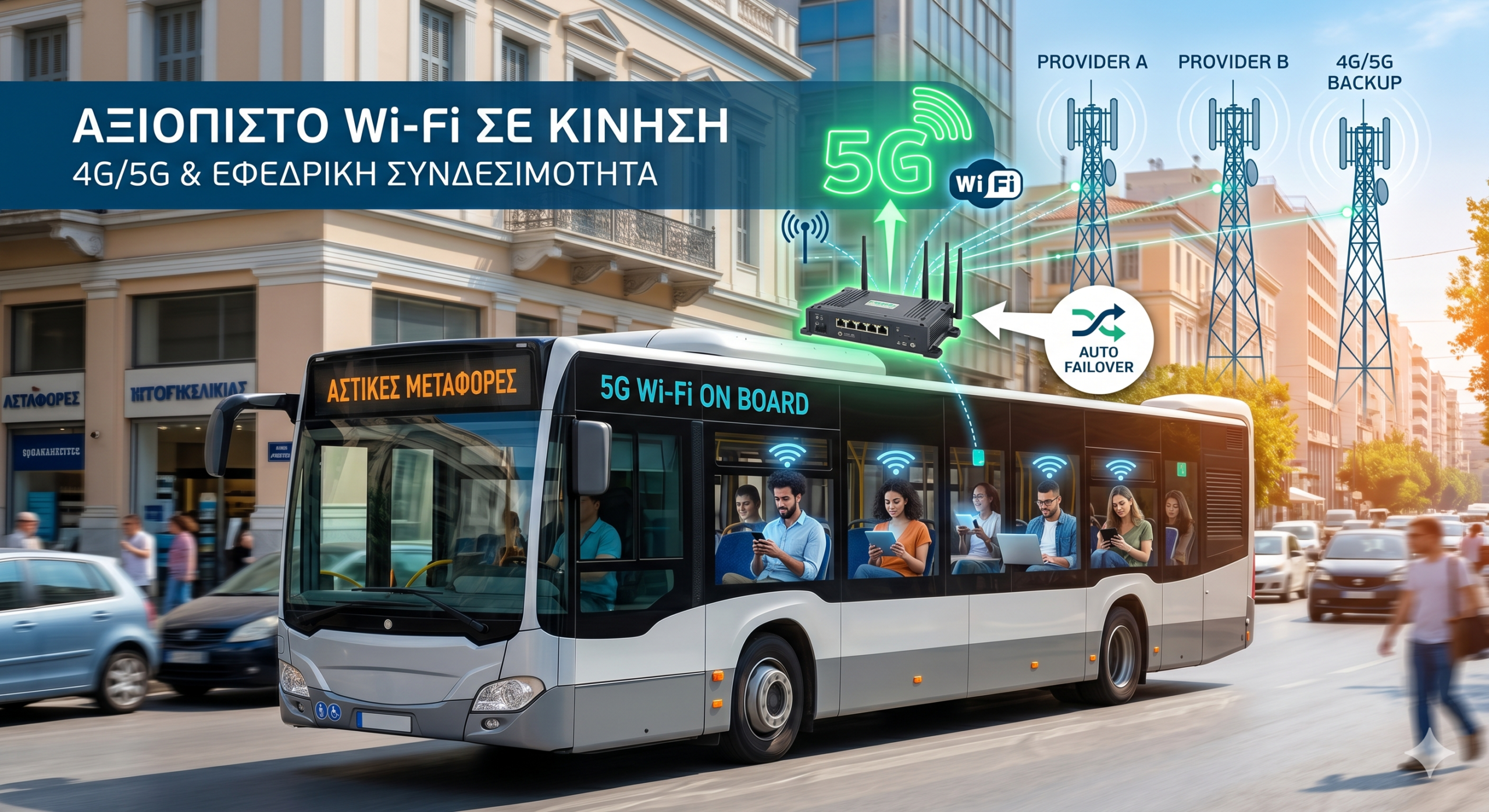
How can a guided city bus provide reliable Wi-Fi to passengers using 4G/5G and backup connectivity
Our goal is to explain how a city bus equipped with a navigation system can provide reliable Wi-Fi connectivity to passengers, leveraging 4G/5G networks and redundant connectivity. We will examine the architecture, failover points, and implementation practices that ensure stability and efficiency.
Scope and benefits for bus routes
It concerns public transport routes with the aim of:
• Reliable Internet access for passengers and fleet employees. • Connectivity management across multiple providers with automatic switching. • Central configuration and monitoring of route and device status.
The approach that combines 4G/5G and redundant connections can improve the passenger experience, facilitate fleet management, and ensure continuous Wi-Fi service on busy routes.
1. Broad connectivity architecture on the bus
Main in-vehicle network components
For reliability reasons, we separate passenger Wi-Fi traffic from the fleet management and telematics network. Example: a mid-sized bus uses a cluster of access points (APs) for passenger SSIDs, while a separate equipment management network supports telemetry and AV control panels.
Key components include in-vehicle routers, Wi-Fi access points, and third-party provider interfaces. Set up firewall rules that separate VLANs for passengers, drivers, and maintenance. For example, set VLAN 100 for passengers and VLAN 200 for telemetry, with restricted access between VLANs.
For uninterrupted operation, implement redundancy with dual routers and multiple provider connections. Practical tip: Configure hot-standby failover and keepalive checks to the primary provider. Integrate platforms like InControl to monitor equipment status and detect parameter changes in real time.
Network topology in small and large vehicles
Small vehicles: Install compact, high-density AP arrays to eliminate dead zones. Example: a delivery van with four roof-mounted APs covering the interior length of 12 meters, plus a compact router in the back for easy maintenance. Make sure no AP array leaves any area without coverage.
Tip: Use a heatmap coverage map and place APs at different heights to reduce interference. Use PoE switches to minimize cabling and make upgrades easier.
Large vehicles: Implement a hierarchical topology with internal backhaul and external uplinks. Separate zones for public access, traffic management, and boarding. Ensure user authentication in the platform’s built-in databases to simplify access control.
Practical tip: In large buses, thermal conditions can reduce the performance of APs. Ensure adequate ventilation around equipment racks and consider using fans with temperature sensors to avoid performance limitations.
2. 4G/5G connection with uninterrupted operation and the ability to choose a provider
Connecting to different providers
Backhaul interconnection with multiple providers
Stable connectivity requires simultaneous access to two or more providers. This way, the router on the bus can automatically switch depending on signal quality, network congestion, or price negotiation.
Centralized connection management is required that monitors each SIM’s availability and bandwidth demand. Fleet management systems connect to platforms like InControl for both predictive maintenance and dynamic tuning.
Supplier selection criteria and data plan setup
• 5G and 4G coverage on all routes, with downloads in areas with reduced signal. • Flexible data supplies, with the option of charging per contract or based on usage. • Support for roaming between providers and compatibility with fleet management systems. • Built-in QoS capabilities to prioritize data transport applications and passenger services. • Signal simulation tools and automation of switching to maintain continuous connectivity.
3. Backup connection and failover strategies in case of failure
Nearby and redundant 4G/5G connection as backup
Address availability with local backhaul redundancy on each vehicle router. Structured side-by-side SIMs and multiple carriers allow for seamless switching of passenger Wi-Fi services.
Local routers connect to two or more providers simultaneously via multi-SIM, designating a primary provider for normal hours and a backup to avoid outages. Built-in capabilities of the Waveloc platform facilitate status monitoring and automatic switching.
Local network redundancy includes default network priorities and client application traffic regulation. With central management, APs maintain Wi-Fi service and status updates are accumulated without interruption. Conduct quarterly technical audits and document changes for smooth migrations.
Automatic network switching and connection loss management
Automatic switching is triggered when a channel loses signal or reaches its capacity limits. Equipment such as 4G/5G modems and MAX Transit 5G routers perform rapid switching with minimal impact on the user experience.
Outage management aims to maintain current sessions and application connections. Real-time monitoring assesses connection quality, while policies direct data traffic first to critical service components and then to the background.
I recommend some sensitivity thresholds: 70% signal quality and 80% data transfer rate as warnings for proactive rerouting before outages become apparent.
For service providers, conduct annual performance assessments using key performance indicators (KPIs) such as switching latency, failover time, and session continuity. This ensures that the local network remains resilient to city-wide outages and aligns with Waveloc best practices.
4. Capacity, QoS and passenger experience management
Bandwidth management and streaming priorities
Bandwidth management should be done at the router and fleet management platform level. Prioritize passenger applications like video streaming and work, while critical vehicle services maintain a minimum guaranteed bandwidth.
Use QoS policies that define zones for existing traffic, with dynamic adjustment per routing hour. On busy routes, passenger flows are slightly restricted to prevent overloading.
User authentication models and usage tracking
Implementation of a central user authentication mechanism for all Wi-Fi access with simultaneous integration into cloud platforms. Passengers are connected with fixed accounts or temporary sessions, depending on the operator's policy.
Truly track data usage by route, by device, and by app. Reports will help with maintenance planning, resource reallocation, and a better audience experience.
5. Network security and privacy
##
Threat management and access security
Security starts with how you access the network. Use strong authentication, device trust verification, and role-based policies to grant access to the vehicle infrastructure. For example, maintenance technicians must undergo MFA before they can access bus management.
In-vehicle network segmentation limits passenger access to critical systems. Implement fixed VLANs or micro-segmentation in control and data entry zones.
• Encrypt data in transit on the backhaul network and on the local network. Use TLS 1.3 and Datagram Transport Layer Security where possible. • Real-time threat detection with behavioral monitoring and alerts. Implement basic behavior, anomaly alerts, and rapid quarantine protocols. • Control access to management devices through MFA and roles. Implement least privilege and periodic access reviews.
Sanctions and passenger data compliance
Follow data minimization principles and use data solely for the purpose of improving connectivity services. Document what information is stored and for how long. Maintain a data inventory and retention schedule that can be verified by auditors.
Implement data retention and deletion policies in accordance with regulations, paying particular attention to location data and user identification. Ensure access logs are transparent but limited. Record access metadata and implement access audits on a quarterly basis.
• Block third parties without consent from sensitive data. Limit third party access to strictly necessary data. • Usage monitoring reports limited to resource and performance reports. Focus on resource usage metrics, not personal information. • Restrict access to passenger data by maintenance or fleet management personnel. Implement separate credentials for maintenance teams and operations teams.
6. Remote vehicle monitoring and management
Central device and fleet management platform
A central platform allows for real-time configuration of all network devices. Through cloud-based management, you can view routing status, equipment health, and program updates.
The platform connects to the MAX Transit 5G and other vehicle components, enabling centralized data movement rules, remote upgrades and event analysis.
Data movement applications for forecasting and maintenance
The applications leverage data from vehicle sensors, connection history, and passenger numbers to predict maintenance needs. This allows repairs to be scheduled before signs of wear and tear appear.
Real-time energy consumption trends and resource management are used. Reports help the manager improve route availability and fleet efficiency.
7. Marketing, content and leveraging connectivity
Forms of advertising and passenger services
The built-in Wi-Fi infrastructure opens up new possibilities for targeted experiences during the journey. Operators can recommend local content, advertisements and offers based on the route or time of day.
Passengers often ignore ads, but with carefully placed content they can be made more effective. The experience must remain reliable and non-intrusive.
Ways to leverage the platform and use analytics
A cloud-based management platform allows for the storage of usage data, which makes it easy to generate reports on content demand and subscriber behavior.
With data analysis, the operator can tailor offers per route, support marketing studies and design loyalty programs. Proper analysis leads to better utilization of connectivity without excessive network burden.
• Ability to set content based on geographic location and time period. • Data usage reports by route and by content type. • In-vehicle content management platform for faster localization.
How is Wi-Fi reliability ensured in high-traffic areas?;
Reliability is based on an architecture that includes multiple backhaul providers and redundant connections. Data is transmitted simultaneously over 4G/5G and, when necessary, over an alternative network, such as satellite or wireless backhaul.
Automated failover is used for fast and seamless network switching. Dynamic resource management maintains quality of service during peak periods and adjusts bandwidth allocation per user.
Example on a bus in a large city: when many users gather in a corridor, the system adjusts coverage and prioritizes video from optional services for passengers with really fast data transfer rates.
What are the minimum hardware and network requirements?;
A 5G/4G router with dual SIM capability and failover is required. Local Wi-Fi access points with sufficient coverage throughout the vehicle are required, including dead zones and safety zones.
A device management center connected to the back-end platform for real-time configuration is essential, as well as the ability to store data in a local cache for 24 or 48 hours.
How are connections managed during scheduled stops?;
During a stop, local caching and data stream optimization are enabled. Connections are boosted with local hotspots for users who remain connected, while applications such as flight and weather updates are prioritized.
Real-time monitoring limits usage, prevents overload and ensures that passengers continue to access resources without delays. At the same time, SLAs are recorded, while alerts allow immediate response to network performance issues.
Conclusion
Implementation policies and next steps.
On a practical level, transport companies need to establish clear policies for planning, testing and maintaining connectivity on the move. We recommend piloting on limited routes before wider implementation.
Assess the necessary redundancy and regular updates of devices through cloud-based management. Define performance monitoring and prioritization mechanisms for high-volume and streaming data.
The impact on passenger experience and fleet efficiency
Reliable internet access translates into increased productivity during travel and a more enjoyable experience for passengers. Dynamic bandwidth management reduces delays caused by congestion.
Centralized monitoring mechanisms improve route availability and equipment maintenance. Thanks to predictive models, repairs can be scheduled before a failure occurs.


